Stablecoin Savings vs Tokenized T-Bills in 2026: Which Yield Wins?
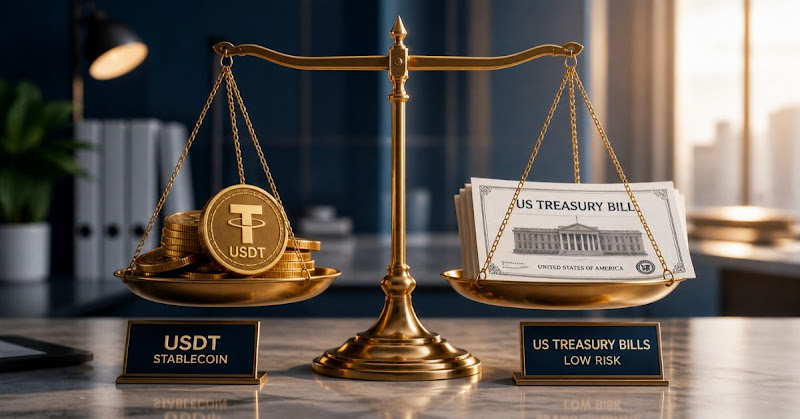
If you want to increase your crypto holdings without being swayed by the intense price fluctuations of Bitcoin and Ethereum, maybe you've heard of two popular options: "Stablecoin savings" and "tokenized T-bills." Both are close to a "safe" yield. But which is actually more suitable for you in 2026. We will discuss this in this blog.
What Are Stablecoin Savings?
Stablecoins such as USDT, USDC, and DAI are digital currencies pegged to USD. Since its value is around $1, there is no need to bet on price fluctuations. But, you can deposit stablecoins into the platform and also take time to earn interest.
This interest comes from lending activities, liquidity pools, or platform-specific programs. Yield fluctuates. Depending on the demand of the platform and market, it may be 5% or more.
One of the most talked about options in 2026 is flexible savings accounts. They provide competitive APY (annual interest) for stablecoins such as USDT. If you want to earn interest on USDT without having to lock funds for months, you can deposit and withdraw at any time with a flexible saving account. Such liquidity is a major benefit to active cryptocurrency users.
What are the main risks of stablecoin deposits? It is a platform risk. Not all platforms have equal security. If there is a problem with the exchange or protocol, the funds may be at risk. Therefore, it is very important to choose a reliable platform.
What Are Tokenized T-Bills?
Tokenized Treasury bills are a relatively new concept. As we know, this is a blockchain record of conventional U.S. bonds as digital tokens. So, if you purchase this, you will virtually hold the claim for the actual Tokenized T-Bills issued by the U.S. government.
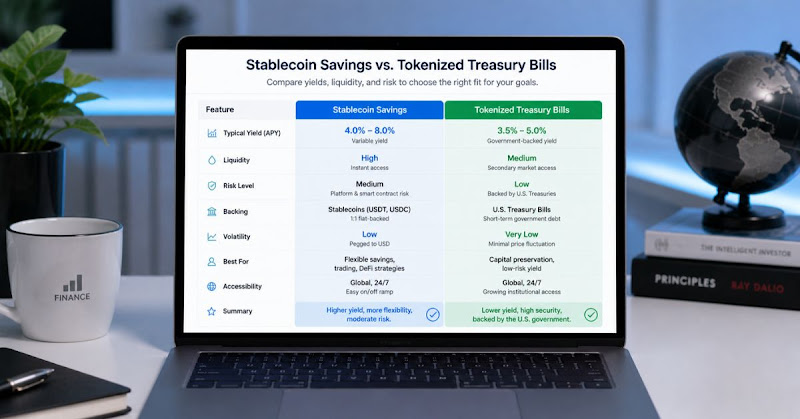
As of 2026, several projects and regulated financial platforms are offering tokenized T-bills. The yield is linked to the Federal Fund interest rate and has been in the range of 4 to 5 percent for most of the past year. Therefore, the return is certain and backed by one of the safest assets in the world.
The charm is clear. The security of government debt and the convenience of blockchain-based assets can be achieved.
Stablecoin Savings vs Tokenized T-Bills: A Side-by-Side Look
Yield Potential
Stablecoin deposit products often offer slightly higher APY, especially on platforms with promotional interest rates and liquidity incentive programs. Meanwhile, tokenized t-bills are linked to government interest rates. Although there is stability, an unexpected rise in profit cannot be expected. Under low interest rates, this is a major disadvantage.
Liquidity
In this regard, savings from stablecoins. Especially those with high flexibility, win here. Funds can be deposited and withdrawn quickly. On the other hand, tokenized t-bills may have a holding period or may depend on the liquidity of the distribution market, which may delay the procedure.
Risk Profile
Here, tokenized t-bills take advantage. Because these are supported by the US government. Nothing else is so safe. Savings in stablecoins depend on the stability of the stablecoin itself (do you remember the collapse of TerraUST?) and the health of the platform.
While USDT and USDC are much more stable than algorithmic coins, centralized platforms are always accompanied by some counterparty risk.
Accessibility
Stablecoin savings products are easily available. All you need is a cryptocurrency wallet and an account on the platform that provides savings products. Tokenized short-term government bonds (T-bills) may require KYC (identity verification), use may be limited by the region, or minimum investment amount may be set.
Tax and Regulatory Clarity
Tokenized U.S T-bills are clearly regulated in most jurisdictions. The established tax system applies to interest from U.S. short-term government bonds. On the other hand, stablecoin yields are still in the grey zone in many countries, but as regulations are in place, the situation is expected to become clearer by 2026.
So Which One Should You Choose?
This is really up to the situation.
If you expect maximum flexibility and higher yields, a deposit at stablecoin makes sense. However, only when using a trusted platform and limiting it to a well-established stablecoin such as USDT or USDC.
For robust security and regulatory clarity, tokenized t-bills are a wise choice. Yields are lower, but a sense of security is certain.
Some disperse assets to both. In order to obtain higher APY (annual interest rate), some are allocated to stablecoin savings and some to tokenized government bonds to enhance security. In the turbulent market environment of 2026, it is not a bad approach.
Final Thoughts
None of these options is perfect. Both have trade-offs. However, both tokenized T-bills and stablecoin savings are a real compromise compared to keeping your dollars in their wallet, or taking on enormous market risk.
The trick is to do your research, know the risks and select platforms that have a good track record. In crypto, safe is a relative term - but in 2026, more than ever before there were better tools to manage that risk in a prudent manner.